To properly understand the role of an Art director and be able to apply those skills in my own work, I needed to understand the main differences between different types of directors and be able to identify their contributions.
Creative Director
Creative directors are leaders, they are in charge of creating the message which needs to be communicated to the outside world and cultivating it. They set strict guidelines that designers have to follow in order to accurately communicate the intent. The way in which assets, visuals and audio communicate to the user is fully dependant on the creative director’s decisions and outlook.
“Their ability to translate a strategic vision into effective narratives helps define and maintain a strong visual brand identity, ensuring that every creative expression is consistent with the company’s philosophy and in resonates with the target audience.”
Ied.edu. (2024). Creative Directors: who they are, what they do, and how to become one. [online] Available at: https://www.ied.edu/profession/creative-director.
The role of a creative director does not just stop after creating a plan however. They have to create advanced strategies that will hold up in the long term, preemptively planning the goals and milestones of future campaigns and projects. Creative directors have to always be socially aware and up to date with all the newest trends and technology in order to make sure their projects are timeless and effectively convey their purpose through any channel, media or platform. They oversee any creative assets made by their team of designers and contemplate how to capitalise on new opportunities and be ahead of competition whilst being the most reliable source of persuasion for the consumers.
Summary
- Defining and communicating the creative vision for projects
- Leading and mentoring designers, copywriters, and other creatives
- Reviewing and approving creative work (designs, copy, concepts)
- Presenting ideas and pitches to clients or stakeholders
- Managing budgets, timelines, and resources
- Collaborating with account managers, strategists, and marketing teams
- Ensuring brand consistency across all deliverables
- Staying current with design trends, technology, and culture
Lombard, J. (2016). What Does a Creative Director Do? [online] Mediabistro. Available at: https://www.mediabistro.com/climb-the-ladder/what-does-a-creative-director-do/.
Account Director
The account director is there to ensure that the team does not stray away from their client’s main business objectives. Their goal is to build a strong partnership with the client, to understand where their business stands and what direction it is intended to go in as well as any obstacles, such as rival companies and competitors, that could get between them and their goal. They help their team improve by challenging their ideas and concepts to make sure they are developed accordingly and carefully in order to fulfil their client’s expectations and more. They use this opportunity to pitch ideas and negotiate on contracts with their clients in order to help expand and most importantly improve their business and revenue.
The role of account directors is very versatile. They often oversee projects, to make sure that the creative direction in on brand with the company, and is still within the initial guidelines set by their client. However they are also in charge of timelines and roadmaps, deadlines, resource management and budget often coordinating a wide variety of teams such as designers, copywriters and production staff. Account directions also sometimes serve as mentors for junior designers and new personnel included in their projects.
Zippia.com. (2026). Get the job you really want – Zippia. [online] Available at: https://www.zippia.com/account-director-jobs/what-does-an-account-director-do/ [Accessed 23 Feb. 2026].
Summary
- Leading client accounts within the agency, with overall responsibility for the clientagency relationship.
- Working with planners to interrogate client briefs, by challenging and asking questions, to develop communications briefs that meet business needs in an effective and accountable way. This is done in collaboration with Media Planners and Strategists from roster agencies to ensure integrated work is delivered for the client.
- Supporting the Account Planner in writing inspirational creative briefs and going on to direct the strategic development of creative work, presenting and selling this effectively to clients.
- Ensuring the profitability and growth of client accounts.
- Identifying, developing and converting new business opportunities with existing and future agency clients.
- Negotiating contracts and fees with marketing directors and client procurement personnel.
- Managing the work, performance and professional development of team members.
- Leading and inspiring those outside of the core team, including creative teams and those in other agencies working on the same account.
- Reporting key financial and team data to the agency’s senior leadership, finance and human resources departments.
- Maintaining a detailed awareness of relevant market trends affecting their accounts, and developments in the wider advertising and communications industry.
ipa.co.uk. (n.d.). IPA | Account Director. [online] Available at: https://ipa.co.uk/knowledge/careers-in-advertising/job-descriptions/account-director.
Senior designer
A senior designer is a graphic designer with years of experience, capable of creating impactful and meaningful assets that are highly compatible with the client’s brief. They are trusted to produce high quality original designs and adapt to the style and brand that they are tasked to work with in order to create a consistent brand identity. What separates a senior and a junior designer is their attitude, a senior designer does not wait for someone to push them into improvement, they work on their own accord, voice their ideas and concerns and capitalise on any opportunity they find without asking for permission.
Their responsibilities include the entire timeline of the project, from scamps to wireframes to prototypes to the final outcome. Whilst tasks will often be delegated to multiple designers, senior designers are expected to effectively deconstruct the creative director’s vision and bring it to life with visual elements.
Summary
- Overseeing all design elements, from the conception to final delivery
- Reviewing the work of junior designers to give guidance and feedback
- Having hands-on experience with Adobe Creative Suite and other design software
- Using their strong eye for aesthetics and visual details to ensure a quality final product
- Listening to design needs, coming up with ideas and communicating them to clients and other members of the team
- Delegating design tasks and providing support for junior level design team members
- Maintaining high standards of quality and making sure only the best work is released to the employer or client
- Collaborating across the organization to drive up standards of digital creativity
Celarity. (n.d.). Senior Designer. [online] Available at: https://www.celarity.com/job-description/senior-designer/.
TBWA – #allin or nothing
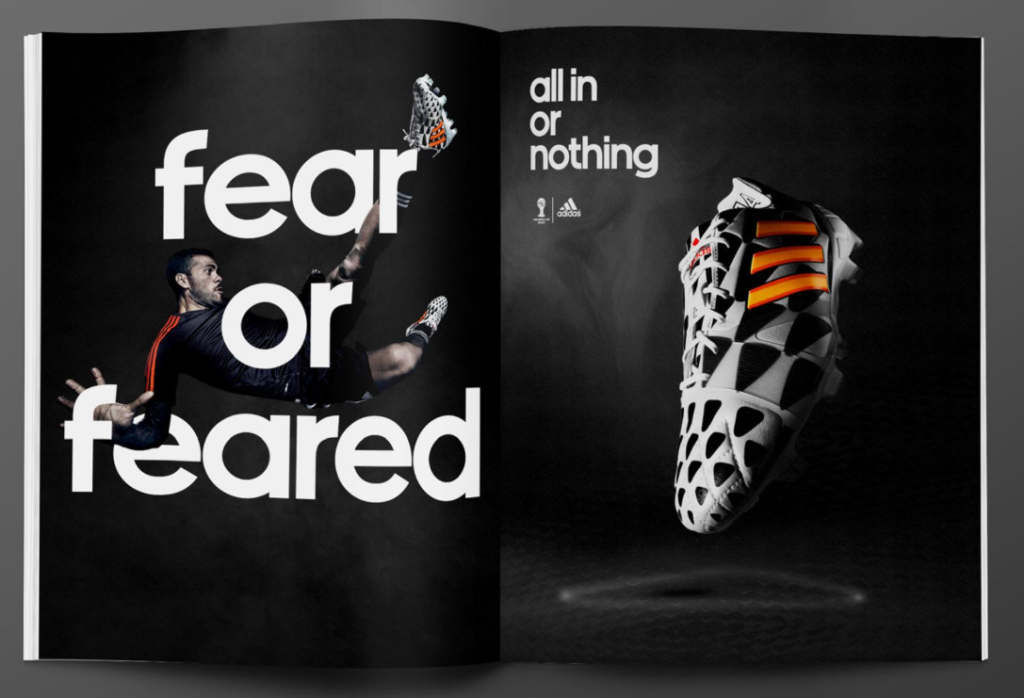

Akafig.com. (2019). Adidas / All In Or Nothing — John Figone. [online] Available at: https://akafig.com/Adidas-All-In-Or-Nothing.
All in or nothing was an campaign created by the agency TBWA for adidas, led by the creative director John Figone. The campaign was a series of photoshoots of the players all over the world participating in the 2014 world cup. They did not know how the world cup would play out, so they organised tons of photoshoots to use throughout the duration of the world cup based on the context of the game, releasing the poster of the player that currently has all eyes on them based on any memorable moments they have in the game.
“#allin or nothing was not just an attitude, but the only attitude that can lead to glory. Nothing is left to chance and everything is left out there on the pitch; the sweat and fearlessness extend from the pitch to the training ground, into the gym and through every aspect of life.”
Shortyawards.com. (2014). adidas #allin or nothing – The Shorty Awards. [online] Available at: https://shortyawards.com/7th/adidas-allin-or-nothing.
The direction in which John Figone has went has been incredibly successful at merging the modern minimalism that adidas prides itself in with the ferocity and determination of the players, up playing the severity of the game by conveying that unless they give it their absolute best, there will be no result. It changes the perspective of the game for the average viewer, it raises the stakes, and despite knowing that it is just a game it awakens a fire in them that makes them want to root for the players, since if they do not win, they are nothing.